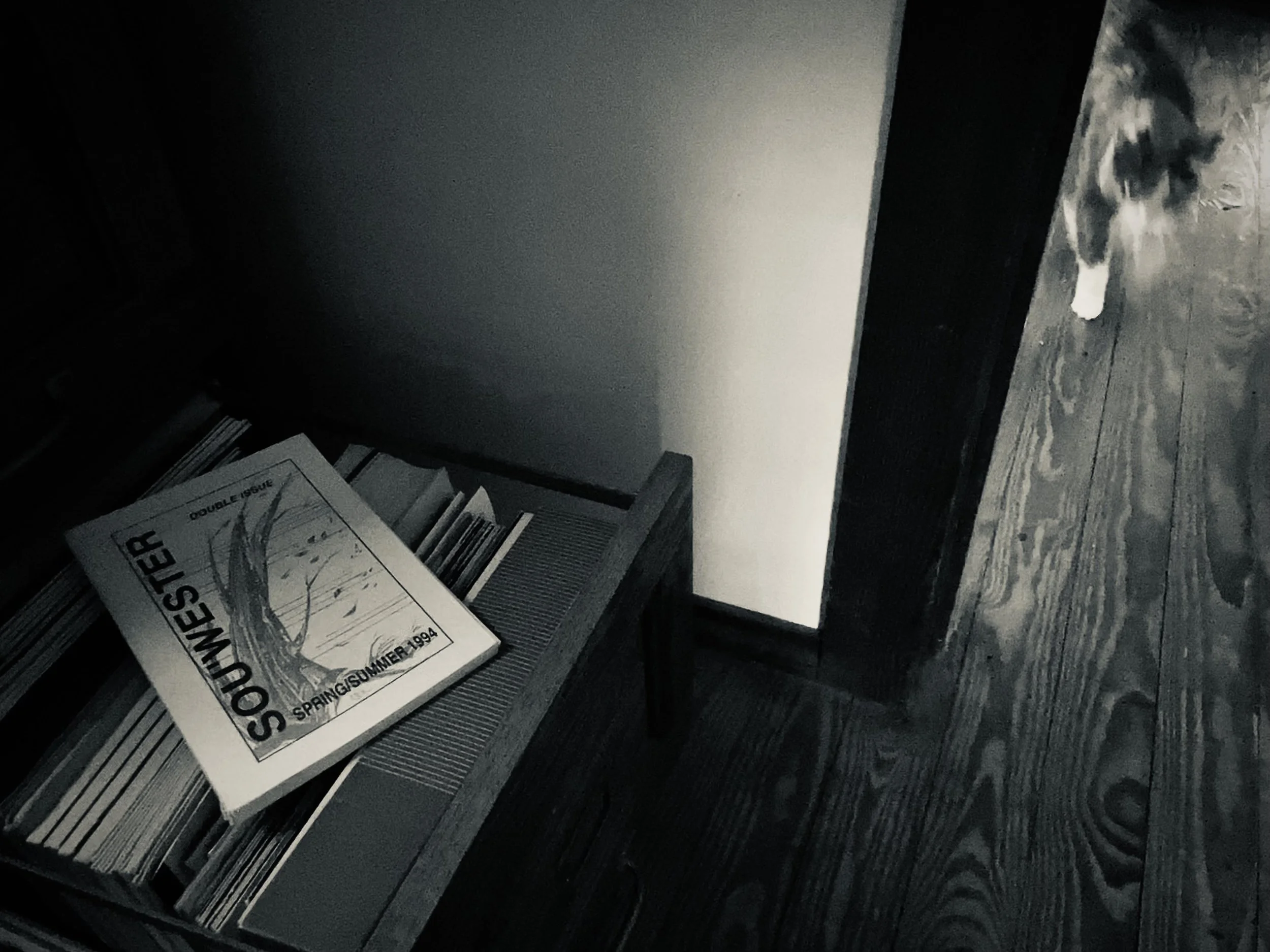
Illustration by Maureen O’Hara PestaNote: Sometimes we find interesting old things lying around, like this funny story by John from a 1994 edition of Sou’wester, a long-gone literary magazine. Enjoy!
The Vocation
Short Story | John Pesta
Grammy always wanted my brother to be a priest. I couldn’t picture it myself. Confessing my sins to that little twerp? Forget it.
But Grammy said he had the eyes of a priest.
“Wouldn’t you like to be a priest someday, Tommy?” she’d ask him, much to the annoyance of my mother, who didn’t like how Grammy kept trying to plant the idea in his head. “You’re a good boy, you’d make a good priest,” She’d say, handing him a big bowl of ice cream and strawberries or something like that.
I’d get a little bitty bowl — I wasn’t supposed to get fat — I was supposed to grow up to be thin and beautiful so l could marry somebody rich.
One Sunday afternoon Grammy, Mom, Aunt Florence, Aunt Julie, my little cousin Susan, and I were clearing the table and doing the dishes when out of the blue Grammy announced, “I’m making a novena for Tommy.”
When Mom did not reply, Aunt Julie shot a worried glance from one to the other and said, “A novena? What for? Is something wrong with him?”
“No, there’s nothing wrong with him,” Grammy said brusquely, as if her younger daughter had asked a stupid question. She rinsed her soapy arms under the faucet then turned, nodding to Mom: “I started the novena last Wednesday. Every morning I walk up the hill to church, and I ask God to give him a vocation.”
“I wish you wouldn’t,” Mom said, “I don’t want him to be a priest.” I guess she realized she sounded like she was looking to fight about it, for she tried to smooth things over with a tinny laugh.
“It’s not up to you,” Grammy said. “It’s up to God. It’s what God wants that counts.”
Mom couldn’t keep from saying, “Then God better want someone else, because my son is going to Lehigh and study to be an engineer.”
“What have you got against the priesthood?” Aunt Florence asked, narrowing her eyes. She was tall and slender and not-bad-looking, but for some reason she wore baggy dresses that completely hid her figure. She must have been around forty then.
“Nothing,” Mom said, “I don’t have anything against priests. I just don’t want Tommy to be one. I want him to accomplish something. He’s going to make something of his life.”
“Oh, and you don’t think a priest has made something of his life?” Aunt Florence said, adding in sharp, icy syllables, “If you ask me, I would say a priest has made the most of his life.”
“That’s right,” Grammy said.
“Now let’s not fight,” Aunt Julie said. “It’s too nice a day to argue.” She tried to change the subject by asking me if I was looking forward to starting high school that fall.
“Yeah, uh-huh,” I said. “But I’m not looking forward to wearing that stupid uniform.” The girls at Steepleton Catholic had to wear white blouses with dowdy blue jumpers that had to be at least one inch below the knees. The nuns carried little cloth measuring tapes, and they would measure. This led to a debate about school clothing. Mom said she didn’t see why the kids in Catholic school couldn’t “at least wear jeans, like they do in public school,” and Grammy and Aunt Florence took the opposite position.
My opinion was not sought. I sat at the kitchen table half listening and staring out the window. Aunt Julie was right, it was a nice day. Sunlight flickered through the old weeping willows, and roses bloomed in abundance along the fence that ran beside the alley. Susan tried to talk me into going out back to see the new kittens in Grampop’s workshop, but I didn’t want to. It was nice and cool in the big old house, but hot and still outside. I didn’t want to get all sweaty. Moments later Susan appeared in the pantry window, walking slowly along the pebble path between the currant and blackberry bushes. I watched her stop to pick some currants. I too liked eating them. They were delicious, although the first few you ate had a strange bitter taste that numbed your teeth. But once I started, I couldn’t stop eating them.
Tommy and Susan’s brother Frankie were in the side yard throwing stones across the alley at the electrical substation, which resembled a giant jungle gym surrounded by barbed wire. Frankie was two grades behind me and Susan was six, a year younger than Tommy. When Tommy spied her, he picked up a fallen plum or something and threw it at her, but it missed by a mile. She stuck her tongue out at him and ran to the shed. That’s telling him, Susie, I said to myself.
I began to feel drowsy. My stomach was stuffed with chicken and roast beef and homemade ravioli. I wondered if Grampop, Dad, and Uncle Frank had fallen asleep watching baseball in the front parlor. All I could hear from that end of the house was the monotonous voice of the TV announcer. Watching baseball would put anybody to sleep ...
“I’m gonna start praying for you too,” Grammy was telling Mom, who now had an impish grin. “Soon as my novena for Tommy is done, I start one for you.”
What had I missed?
Aunt Julie said, “Joyce doesn’t mean it, do you, Joyce?”
My mother said, “I most certainly do.” She looked supremely pleased with herself.
Grammy grew visibly upset. Shaking her head, she squeezed behind my chair to push open the cellar door. She was short and wide, distinctly bell-shaped, and to make room for her to get through I had to scoot my chair in, pressing my body against the edge of the white wooden table. Aunt Florence followed her downstairs, and I could hear my aunt whispering, “You can’t talk to her. You say something that makes perfect good sense, but instead of trying to see your point she says something that’s not even remotely connected to what you’re talking about.”
Grammy mumbled something in Italian, which I did not understand.
Aunt Julie said softly, “You wouldn’t really leave the Church, would you, Joyce?” Her brows wrinkled with concern.
Mom shrugged. “Who knows? If the Catholic Church doesn’t wake up one of these days, it won’t have any people left in it.” She seemed finished but suddenly thought of something else. “It’s just a bunch of old men sitting over there in Rome. What do they know about raising a family and making ends meet?”
“I know how you feel,” Aunt Julie said. “But the way I look at it is you should work to change things from inside the church, not outside.”
“They say there’s a shortage of priests. If they want more priests, they should let them get married. Or why don’t they let nuns be priests?”
Like a diplomat, Aunt Julie said, “I wouldn’t be surprised if both of those things happened someday, but you know what they say — the mills of Rome grind slowly.”
“They ought to make Florence a priest.”
I didn’t think Mom meant it about leaving the Church. Even though she seldom went to Mass, I had never heard her talk about giving up her religion. Often she just said things for effect.
On the way home, Mom got into it with Dad. “I try to keep my mouth shut,” she said after explaining what had happened in the kitchen, “but I wasn’t in the mood for it today. You know what she’s trying to do, your mother, she’s trying to brainwash him, that’s what she’s trying to do.”
Dad pooh-poohed the idea. “Come on, she is not.”
“Why doesn’t she ever work on Frankie? I never hear her telling him to be a priest.”
I put in my two cents’ worth: “She thinks Tommy’s a sweet quiet little angel. Hah!”
We were sitting in the back seat, and Tommy glared at me with his big brown priestly eyes. “Shut up,” he said.
“You shut up,” I told him.
“No, you!”
“You!”
Dad said, “Both of you shut up.”
Tommy proudly announced, “Grammy said she’s asking Jesus to call me.”
“See?” Mom said. “See what I mean?”
Dad said, “Then don’t answer the phone.” He turned his head a quarter of the way around and winked at me.
Tommy said, “Mom, you don’t wanta go to Hell when you die, do you?”
“What?” Mom said, now sounding genuinely alarmed. “Who put that in your head?”
“Butchie says if you don’t go to church, you go to Hell when you die.”
Tommy was just repeating what he’d heard at school. Mom was probably disappointed that she couldn’t blame Grammy.
“Then I guess that’s where I’ll end up,” she said.
That worried my brother. He jumped up and wrapped his arms around her neck from behind. “Don’t go to Hell, Mommy.”
Dad laughed, “Maybe he should be a priest. ‘Father Faccinetto’ ... it’s got a certain ring to it ...”
“Now don’t you start encouraging him too,” Mom said. “Not if you know what’s good for you.”
* * *
About a week later Mom got a call from Aunt Florence asking if we would take Grammy to the doctor for her check-up Thursday night. Grammy was always going to the doctor for one thing or another. Aunt Florence was usually the one who took her, but her car was in the garage for a few days. Mom tried to get out of it by saying Dad was working the second shift at Bethlehem Steel — “Couldn’t Julie take her?” No, Aunt Julie and Uncle Frank had other plans that night. So Mom had little choice but to agree.
Tommy and I got dragged along. Neither of us wanted to go sit in a waiting room half the night, but Mom never liked leaving us alone in the apartment at night, and no doubt she wanted somebody to talk to besides Grammy.
Grammy was sitting on the front porch when we pulled up. Holding onto the railing, she hurried down the short flight of concrete steps and waddled across the front of the house, then she squeezed open the handle on the iron gate, closed it carefully behind her, and climbed headfirst into the car. “We gotta hurry,” she said, out of breath. “My appointment’s at 6:30.”
“I know. We’ll make it,” Mom said. “There’s plenty of time.”
“You have to go to Florence’s first. She’s coming with us.”
Mom groaned. “What for?”
“She wants to talk to the doctor about my pills.”
“She didn’t tell me she was going,” Mom said.
“It’s okay,” Grammy said, still breathing hard. “You just gotta step on the gas. I thought you’d be here sooner.”
Mom sighed. Aunt Florence lived in Fountain Hill, the opposite direction from the doctor’s office. She glanced in her side- view mirror then made a sharp U-turn and headed back toward Susquehanna Blvd. I know she felt like saying something, but she managed to control herself.
Aunt Florence had a brick ranch home that was beautifully landscaped and surrounded by a wide, lush, immaculately green lawn. She worked in the office at Steepleton Hospital. I saw her watching for us through the bay window of her living room. The lights inside the house went out; an antique lamp by the sidewalk came on; and the front door opened. She wore a light gray and white cotton dress that swished in the breeze as she walked, making her look almost sexy for a change.
“Hello, Mother. Hello, Joyce.” Opening the back door, she added, “Hi, Amy. Hi, Tommy.” She squeezed in beside us. I was stuck in the middle, with my feet on the hump. “Mother and I really appreciate your picking us up like this, Joyce,” she went on. “It’s really nice of you, isn’t it, Mother?” She sounded so friendly. “Isn’t the weather beautiful today? When I got home from work, I sat out on the patio for half an hour just to watch the clouds floating through this beautiful blue sky.”
“The clouds are pretty,” Mom said, making an effort to meet her sister-in-law halfway.
“Pretty as a picture,” Aunt Florence said. “And we should have a glorious sunset too. Maybe we can sit out back later and watch it together — if it’s not too late when we get home.”
As we sped back to town, Aunt Florence did most of the talking: she liked Mom’s new hairdo; she asked about Dad; she wanted to know if we were still looking at houses; she said she hoped we found a house we liked. “You have such a flair for interior decorating, Joyce, you’d really have fun decorating a house of your own,” she said. All this flattery rubbed me the wrong way, but I wondered if it was merely my own suspicion that made me think she wasn’t sincere, for I had to give her at least a little bit of credit for trying to be nice and to get along with Mom.
All this while, Grammy looked nervous. She kept fidgeting with her fingers, saying little. Mom glanced over once and asked her how she was feeling. Grammy shook her head and said, “Those pills he gave me don’t do nothing. My heart still skips.”
“Don’t worry, Mother, we’ll get you some new medication,” Aunt Florence said, patting her on the shoulder.
“This doctor’s a quack,” Grammy said. “He’s nothing but a pill doctor.”
I saw Aunt Florence make a little frown, as if preparing to contradict this point, but she only said, “Everything will be all right. Doctor says you’re doing fine.” For the benefit of the back seat, she added, “Grammy always worries when she has to go to the doctor. None of us likes to go to the doctor, do we, Tommy?”
“Uh-uh!” he said emphatically, which I took to mean like right now especially.
We had to sit in the waiting room over half an hour with three other people, two of whom looked pretty decrepit. I wondered what kinds of germs were floating around in there, and I began breathing as shallowly as possible. I picked up a copy of Scientific American and found an article with pictures of what a fetus looks like at different stages of development.
Finally Grammy was called in to see the doctor. My aunt asked Mom if she wanted to go with them, but Mom said no, she’d stay with us. Mom looked tired. She’d had to work overtime today at the factory and hadn’t got home till after four. When she saw me watching her over the top of my magazine, she smiled and said, “What’s that you’re reading?”
“Nothing,” I said.
Ten minutes later Grammy and Aunt Florence were back. My aunt was all smiles, talking to the doctor in her professional, hospital voice. Grammy looked stronger, relieved, clutching her new prescription. She paid her bill eagerly — she didn’t like owing people money — then she held out her hand for Tommy to hold as we left the office, which was in a row of tall homes on Fifteenth St., and crossed under over-arching trees to the car. This time I grabbed the window seat.
We went to Walgreen’s for Grammy’s new pills, and I thought that someone would offer to treat us to an ice-cream sundae or banana split, but, as we waited for the pharmacist to fill the prescription, Aunt Florence said, “Joyce, before you take us home, there’s one more stop I’d like us to make — a friend of mine’s.” Tommy said he had to go to the bathroom, but Aunt Florence said he could go at her friend’s house. “She won’t mind. She’s a very nice lady.”
Mom held back. “I don’t know ...”
“Oh come on,” Grammy said. “It’s not late yet. You have time.”
Mom’s shoulders sagged as she started the car. She must have felt trapped. Aunt Florence guided her across the north side of town, then over the bridge into Fullerton. The friend lived in a nice neighborhood. She had a two-story brick home with a sharply peaked roof. The front of the house was almost completely hidden by large bushes, and the grass needed cutting — it was five or six inches high and full of clover and dandelions, nothing like my aunt’s lawn, which made me think it was strange that they were friends, but that was a silly thing to think.
Mom said, “Amy and I’ll wait for you out here.”
“Don’t be silly,” Aunt Florence said. “You come too. I want you to meet Margaret. She’s very special.”
“What must you do here?” Mom asked.
“Come on,” Grammy said. “Tommy needs to go the bathroom.”
The five of us made a little procession up the overgrown slate path. Lightning bugs rose from the grass. My aunt pressed the doorbell, and chimes rang inside. A stout, round-faced woman who must have been in her mid-fifties opened the door and beamed at us. She wore a black dress with a heavy gold necklace and crucifix. “Florence!” she said, hugging and kissing my aunt. Her name was Margaret O’Hanlon, and she hugged and kissed each one of us in turn. I caught a faint whiff of powder — lavender, I think.
“Welcome to my home,” she said. “May I get you something to drink? Lemonade? Iced tea?” Her eyes were large and round.
“No thank you,” Mom said, “but my son needs to go to the bathroom,” and the other three women laughed.
“This way, Tommy,” Margaret said. “My, but you’re a fine-looking young man. I have a nephew named Tommy. He goes to college now. The bathroom is right down this hall. Here we are.”
“Margaret is a saint,” Aunt Florence whispered to Mom. When Margaret returned, she beamed again and said, “Joyce, I’m so happy to meet you. Florence has told me so much about you and your lovely children. You really have been blessed.”
“Thank you,” Mom said uneasily, as if she didn’t know what else to say.
“Let’s sit down, shall we?” Margaret said, leading us into the living room — or what should have been the living room. Actually it was more like a shrine.
There were pictures of Kennedy everywhere. A large portrait of the President, draped in black, hung over the white mantelpiece, with six votive lights flickering beneath it. Dozens of photos of Kennedy and his family covered the walls. In front of the fireplace was a kind of altar with a large golden cross standing in the middle, tall candles at each end, and several small American flags in between. An oak lectern stood next to the altar, and a sofa, two armchairs, and eight padded folding chairs were symmetrically arranged facing the speaker’s stand. Mom and I exchanged glances. I suspect that curiosity outweighed apprehension in both of us.
“Margaret is a great admirer of President Kennedy,” Aunt Florence said.
“I see that,” said Mom.
“It was a terrible tragedy when he was taken from us,” Margaret said. “A terrible loss. It’s six years now since he was assassinated, but to me it seems like yesterday. We’re still paying the price for that terrible deed, and we will go on paying it for a long time.” She made the sign of the cross. “Help us, Lord. Help us to overcome the evil forces now rampant in the world.”
Tommy came back from the bathroom and stopped in the archway, staring. Grammy told him to come sit beside her on the sofa. Margaret asked him if he would like some cookies and lemonade, and he had enough sense to say yes, which meant I got some too. We all did, except Mom, who didn’t want any.
While we ate our snack, Margaret asked Tommy and me about ourselves — what we liked to do, how we liked school, what we wanted to be when we grew up, but she seemed more interested in Tommy than me. Then she told Mom to thank God that she had such good, healthy children.
“Children are a wonderful thing,” she said, “a gift from God. But they are given to us only for a time, then they must go their own way, to fulfill their own destiny.” As she said this, she rose and meandered about, finding her way to the lectern. “We are all children — children of God — and, like little children, we must learn to overcome our selfishness. We must share with one another, give to one another ... in this way the world can become a better place.”
She let this thought sink in, then suddenly her voice rose and she pointed at Mom: “Joyce Faccinetto, you have so much to be thankful for — a hard-working husband, two lovely children — but you too must learn to share. If the Lord wants a child of yours to serve him, you must not protest, you must not stand in his way, or great suffering will result.” Her face grew tender, compassionate, yet her voice was stern: “Joyce Faccinetto, listen to me. I have it on good authority, and tonight I myself have sensed that the Lord may be calling your son to serve him. Don’t stand in the way of this, Joyce.”
“Now wait a minute,” Mom began.
“Listen to me, Joyce,” Margaret repeated, cutting her off. “I can see into your heart, Joyce. I know you better than you perhaps know yourself. You are clinging too possessively to that which is yours only for a time. You must learn to let go. Go to church, Joyce. Pray for God’s help. He will help you. For if you do not ... if you oppose God’s will ... if you put your own selfish desires ahead of what God desires, you will lose what you hold most dear. ...”
“What’s that supposed to mean?” Mom shot back. Her face was red, her back rigid.
“Mrs. Faccinetto,” Margaret said to Grammy, “would you mind taking the children out of the room.”
“The kids can stay right where they are,” Mom said, growing more angry by the minute.
I glanced over at Tommy. He was sucking his thumb, a habit that I thought he had grown out of. Grammy noticed and tugged his thumb out of his mouth.
“Very well then,” Margaret said. “I say this for your own good and that of your family.” She pointed at Mom again, and I half expected lightning to shoot from her long sharp fingernail. “Joyce Faccinetto, dear Joyce, if you persist in opposing the Lord’s will, he will claim that which is his. Your son will be taken before his time, before he has had the chance to fulfill —”
“I’ve had enough of this,” Mom said, jumping to her feet. “Come on, Amy, Tommy, we’re getting out of here.”
Aunt Florence said, “Joyce, wait.”
Mom had Tommy by the hand, pulling him toward the door, and I was right behind. “Who the devil does she think she is?” she muttered. “Trying to tell me my son will die? She must be crazy. She’s insane. They’re all crazy.”
“Don’t be such a baby,” Grammy called from behind. “Wait for us. You must drive us home.”
Aunt Florence was saying, “Thank you, Margaret. I’m sorry it turned out this way.” I looked back and saw Margaret give her a forgiving martyr’s smile.
Mom kept muttering all the way to the car. I believe she would have left Aunt Florence and Grammy behind if I hadn’t left the car door open and they hadn’t come running out after us. There was dead silence in the front seat, but my aunt kept up a steady stream of chatter for the sake of Tommy and me. “Oh look at that, another fast-food shop going up over there. ... See how pink the sky is now, isn’t it beautiful? ... There are so many potholes in the road this year ...” Mom drove faster than I had ever seen her drive before, hitting every bump. She ran a red light, and another car blasted its horn at us. Grammy held on for dear life, moving her lips in silent prayer, and Aunt Florence squeezed our hands and patted them, as if pitying and consoling us for having such a wild and dangerous mother.
* * *
Mom stopped talking to Grammy and Aunt Florence. She said she didn’t care if she never saw them again. If Grammy called up and Mom happened to answer the phone, as soon as she heard Grammy’s voice she would lay down the receiver and call Dad or me to the telephone. But at least she didn’t hang up. I’d watch Dad rolling his eyes as he listened to Grammy’s side of things. He was caught in the middle, and he didn’t like it. Once I heard him tell Grammy that she never should have taken Mom to that Kennedy fanatic’s house, and I could hear Grammy start crying and scolding him, loudly defending herself on the other end of the line: “This is the thanks I get for raising you,” she said to him, among many other things. “I don’t know why you couldn’t marry a nice Italian girl.”
Dad still went to Grammy’s house once a week or so, but Mom stayed mad and wouldn’t let Tommy and me go with him. “I won’t have her turning my own children against me,” she’d say. Dad didn’t try to contradict her. He probably thought it was just a matter of time before the whole thing blew over, and he didn’t want Mom to stop talking to him too — he hated it when she gave him the silent treatment. But Mom had no intention of making up with her in-laws. If she told me once, she told me twenty times that she could kick herself up and down the steps for not “throwing a fit and putting your grandmother, your aunt, and that dizzy Margaret in their place while we were still there in that crazyhouse that night.”
Things went on like this for half the summer, then one Sunday afternoon Dad came home from Grammy’s and sat down at the kitchen table, shaking his head.
“What’s wrong with you?” Mom asked him.
“It’s strange. It’s hard to believe,” he said with a glazed look in his eye.
“What is?” Mom asked. She was ironing shirts; I was folding towels; Tommy was playing electric baseball on the floor, the big metal game humming and vibrating noisily.
Dad looked at me and Tommy, debating whether he should tell his story in front of us. “Tommy, how ’bout if you take that thing somewhere else?” Dad said. If he thought that would keep Tommy from hearing what he had to say, he was wrong. In five seconds my brother’s ear would be glued to the heating vent in my room next door, which is how we listened in on the kitchen.
“You’ll never guess what I heard today,” Dad said after Tommy had lugged his game away. “Florence told me that our grandfather was a priest.” He shook his head again. “My mother’s father. Can you believe that? Florence knew, but Julie and I never did. My mother told Florence years ago, because she’s the oldest of us kids.”
Mom stopped ironing and sat down. “What do you mean?” she she said. “Did he give up being a priest to get married?”
“No,” Dad said. “He was a priest all his life. He was pastor of a little church back in Italy. Isn’t that something? A priest ...”
Mom nodded, giving Dad’s revelation a careful think. She was wearing a pair of red shorts and was sitting on one leg, with her knees jutting toward Dad. Under the circumstances, her pose seemed provocative, even sacrilegious to me.
Dad, who had been speaking softly all along, lowered his voice another decibel or so, “Florence said Tommy reminds Grammy of her father — my grandfather — I never knew him — Tommy’s great- grandfather. ... Tommy looks more like him every day, my mother keeps telling her, Florence said.”
“So that means Tommy should be a priest,” Mom said scoffing. “I always knew I married into a crazy mixed-up family, but I didn’t know it was this nuts.”
Dad ignored that jab. “It’s really hurting my mother that she doesn’t get to see the kids anymore. I can’t promise, but I don’t think there’d be any more talk about Tommy becoming a priest if I took the kids over there once in a while. In fact, I’m going to take them,” he said. “She has a right to see them. And the kids have a right to see their grandparents.”
Mom took a deep breath, puffing her cheeks. I think she felt he was right but wasn’t willing to admit it.
“It wasn’t my mother’s fault what happened up in Fullerton,” Dad went on. “Florence put her up to it.”
Mom snapped back, “What do you mean it wasn’t her fault? They were in on it together from the start. It was all a plot — just like the Kennedy assassination, only this time I was the victim.”
“Florence put her up to it,” Dad repeated. “Florence said she didn’t think the woman would come on so strong.”
“Oh sure.”
“Florence apologized. She wants to apologize in person — if you’ll listen to her.”
Mom was beginning to weaken. For a moment I fancied her eyes were shiny. She went to the sink for a glass of water.
“I think they learned their lesson,” Dad said. “So whadaya say?”
Mom said nothing. I thought she was being awfully stubborn.
Dad looked at me, and his mouth crinkled. “Some story, huh, kiddo?”
I nodded somberly. I needed time to digest it. All sorts of questions were racing through my mind. Had my great-grandmother ever been married to someone else? Was it a long-running affair that she had had with her priest-lover, or just a one-time fling? Could she tell her sins to him in a confessional booth — how would that work? Would Grammy not be able to go to heaven? Did Grammy feel what I was already beginning to feel, a strange mixture of guilt and pride at the thought that I was descended from a priest?
“All right,” Mom finally relented. “You can take the kids to see her. But not me. I’m not going. And I don’t want Florence coming here either.”
“Okay,” Dad said, “if that’s how you want it. We’ll keep the feud going awhile.”
The feud might have ended soon afterwards, but my brother had to goof things up. That night, when Mom went to his room to tuck him in, I heard her say, “What are these candles doing here?” I sneaked down the hall to see what was going on.
“I need them,” Tommy said. “I want them there.”
“What for?” Mom asked.
The porcelain candlesticks that we always kept on the what-not shelves in the living room now stood on Tommy’s dresser, holding a pair of tall green candles that were still wrapped in cellophane. Gone were the pile of comic books, the plastic model cars that Dad had helped him build, the treasure-chest and slot-machine banks, and the plaster-of-Paris statue of a black bear that he had won at a carnival. These things now lay on the floor in the corner and on top of the radiator, while the only things on the dresser were the candles, one at each end of the lace doily. The mirror above the dresser made them look like four candles, and the mirror also showed me the quizzical look on Mom’s face.
Tommy spotted me in the doorway and yelled, “You get outta here!” He ran over and slammed the door in my face.
But I had seen enough. “It’s an altar,” I called to Mom through the door. “He thinks he’s a priest.”
“I can handle this, Amy,” Mom said.
“Get outta here, you jerk,” Tommy yelled at me.
I retreated down the hall, laughing.
Mom put the candles and candlesticks back where they belonged, but the next day, while she was at work, Tommy retrieved them, and this time he added a white cardboard box that he found in the closet. He took off the lid and set the box upside-down in the middle of the dresser. He cut a T-shaped pair of slits in the front to create a folding double door. It was a ragged cutting job, but he evidently liked the looks of it, for he topped off his tabernacle with the plastic crucifix that ordinarily stood on his chest of drawers, glowing in the dark while he slept.
Most of this work was done with his door shut, but I peeked in whenever he went to the toilet. I wondered if Mom would get mad at me for letting him do it, but I didn’t try to stop him. I wanted to see what Mom would say when she got home.
“Oh no, not again,” she said. “What am I going to do?” Her mouth hung open as she stared at my brother. “Tommy, this looks ridiculous. What would your friends say if they saw this?” I noticed that he had added a ciborium and a chalice in the form of two small brass vases that Mom kept under the sink. The vases were from India, with intricate blue and red designs etched on them.
At supper Dad said, “What harm can it do? If it makes him happy, let him play priest.”
“I’m getting worried about him,” Mom said. “Your mother and sister have put this idea in his head, and now he’s starting to believe it.”
“Come on, you’re making too much out of it,” Dad said. “He’ll get over it in a few days, like everything else.” He hesitated a moment before adding, “Anyway, what’s wrong with it if he wants to be a priest? There are a lot worse things he could be.” He pretended to duck, as if expecting a dish to be thrown at him.
“You’re just like your mother,” Mom said, getting up from the table, tight-lipped and irritated. It seemed as if she meant to show she had nothing more to say to him, but she couldn’t keep quiet about it. “He’s too young to be pushed in that direction. Your mother’s brainwashed him. He’s getting neurotic. We’ll end up having to take him to a psychiatrist.”
“Stop going overboard,” Dad said. “My mother hasn’t even seen him for the past six weeks.”
“She talks to him on the phone,” Mom said. “Maybe I should have the phone taken out. Who needs a phone anyway?”
“Stop blaming my mother,” Dad said, wadding his napkin and throwing it on his plate. For a long time I had been wondering when he would finally get fed up.
“Who else is there to blame?” Mom said.
I chimed in. “He probably heard what you said about Grammy’s father.”
They both stared at me. Mom stared at Dad. Dad threw up his hands: “Okay. Blame me. It’s all my fault.” He shoved his chair back, grabbed the newspaper, and went out to the porch, grumbling.
“It’s his whole crazy family’s fault,” Mom said under her breath. “How’d I ever get mixed up in such a crazy family?“
I didn’t like the sound of that. If she hadn’t got mixed up in it, I wouldn’t be here.
During the next few days, Father Faccinetto’s antics increased. He found some kind of sharp metal ring and began punching out nickel-sized pieces of bread, which he flattened into communion hosts. He used cherry soda for wine. He found a little pitcher and used it as a water cruet so he could rinse his fingers in the brass chalice. Mom put up with all this, I think, because she hoped what Dad had said would come true — Tommy would “get over it.” But on Friday afternoon, when she came home from work tired and cross because she’d had to work overtime again and was going to be late for her hairdresser appointment, and when she saw Tommy standing in front of the altar in a pink chasuble, which I had just made for him out of an old pillowcase, and gazing at himself as he elevated a communion host, it was just too much for her. “That’s it, that’s it,” she said, “no more of this, I’ve had enough,” and she yanked the candles out of their holders, at which Tommy began to scream, and she whisked the crucifix away, and she picked up the tabernacle, upsetting the chalice, which was full of cherry soda, but she didn’t care, even though the doily altar cloth was ruined. Tommy was hanging onto her arm, trying to stop her. Communion wafers lay scattered on the floor, getting trampled underfoot, and my stomach caved in as I witnessed this sacrilege. It was kind of scary. She saw me watching her, and it must have made her feel guilty. She quickly turned away.
She went to the kitchen and heated up a can of Spaghettios. Dad was at work, and Tommy wouldn’t come out of his room to eat, and Mom wasn’t hungry either. After one or two bites, she went to her bedroom and lay down. I don’t know for sure, but I think I heard her crying in there. I cleaned the few supper dishes left, then I watched an old cowboy movie on TV. A half hour later Mom came out of her room and went in to see Tommy. I turned down the TV and heard her talking softly to him. I pictured Tommy with a pillow over his head and Mom rubbing his back.
When they finally came out, they had made up, more or less. Tommy had a brooding frown on his face, and Mom was all red-eyed and wrinkled. Her hair was a mess, but she had given up on the beauty parlor. She seemed self-conscious, and it didn’t work when she tried to pretend nothing had happened: “Tommy and I are starving, aren’t we, Tommy? How about if we go out and buy a pizza?”
That Sunday Dad took my brother and me to see Grammy, and not a word was said about Tommy’s becoming a priest. He stopped celebrating Mass in his room too. So Mom seemed to have won on all fronts. But my brother was acting different. He seemed more quiet and withdrawn. He had always been on the quiet side, but now he started keeping even more to himself.
“What are you going to do today?” Mom would ask with a coaxing smile.
“I don’t know,” he’d reply.
“Where’s Butchie and Steve? I haven’t seen them lately.”
“They’re around.”
Apathy. Lethargy.
Since I was the babysitter while Mom was at work, she told me to do things with him — “Take him swimming or something. He can’t stay in his room all day long. It isn’t healthy.”
“I can’t make him do stuff,” I said. “He tells me to get lost, the little brat.”
“Well at least you could try.”
My thinking was we all have our problems. He’d just have to learn to cope with his.
“I don’t know what’s wrong with him,” Mom said, though of course she did.
“Let him have his altar back, then he’ll be happy,” I said.
“No, we’re not going to spoil him,” she said, but she didn’t sound too sure of herself. In a few weeks we’d be going back to school. She was hoping that if she could just hold out till then, her boy would be normal again once school started up.
One morning his friend Butchie called up, and I told him to come over and help me drag Tommy out of bed. When Butchie arrived, we barged into my brother’s room, which was now kept in an extreme state of neatness. My room wasn’t bad — Mom made us keep things straightened up — but it was an earthquake zone compared to this. “You’ve got company,” I said. “Come on, get up, you’re evicted.” I grabbed his foot and tried to drag him off the bed, but he kicked me in the face. “Outside,” I said. “You’re going outside if I have to throw you out the window.”
Butchie laughed, and Tommy was embarrassed, but it worked. “Leave me alone, you freak,” he yelled at me, rolling off the far side of the bed, then he glared at his friend: “What are you doing here?” They went out back and sat on the porch. I congratulated myself. I felt as if I knew more about handling him than Mom did.
The next day Tommy came running home with his face and shirt covered with blood. He was crying as he held his right temple, and his lips trembled uncontrollably.
“Tommy, what happened?” I felt my insides churn.
“I — I — fell — on a fence.”
He had a deep cut next to his eye, and the blood was streaming out, all over the kitchen floor. I made him lean over the sink, then I got a towel from the bathroom. I got really worried. Tommy kept shaking at the sight of his blood. Snot mingled with the tears and blood that dripped into the sink.
“What happened to you? What happened?” I said again and again.
I called Mom at work, and she came rushing home. The factory was only five minutes away. In the meantime, our landlady, who lived below us on the second floor, heard the commotion and came upstairs to see what was the matter. “Oh my God,” she said when she saw the gash. She wanted to put peroxide on the cut, but Tommy wouldn’t let her touch him. Blood was still flowing down the drain.
When Mom got home, she said the same thing, “Oh my God!” She made a huge bandage out of gauze and adhesive tape, and it immediately turned reddish brown, then we took my brother to the emergency room at the hospital. The landlady drove Mom’s car, and Mom sat with Tommy in the back, squeezing him tight and kissing his head. He moaned and quivered all the way to the hospital.
Later we learned from Butchie what had happened. The kids had been playing kickball in the alley, and Tommy got knocked down as he was running to first base. He fell against an old rusty fence and a piece of broken wire caught him on the face. Another inch and it would have ripped his eye out. The cut took eleven stitches, and he had to have a tetanus shot.
But that wasn’t the worst thing that happened. The following week, while he still had his stitches, Tommy came home one afternoon, went to his room, and fell asleep. I didn’t think anything of it. I was watching the soaps and Bandstand, and I just figured he was taking a nap. He was still asleep when Mom got home and she let him go on sleeping awhile longer, but then I heard her trying to get him out of bed: “Hey, mister, what are you going to do, sleep all day? Come on, get up. Come out here and talk to me.”
She couldn’t wake him up.
Mom grew nervous, then frantic. “Tommy ... Tommyyyy ... come on now, get up!” I went to see what was going on. She was shaking him, but there was no response. “How long has he been asleep?” she asked me.
“I don’t know. He came in a while ago.”
“I can’t get him up.” She rolled him over and felt his forehead. He lay still, hardly breathing. She slapped his face gently and sat him up on the bed, but his head lolled back, unconscious. “Call Butchie,” she said. “See if he knows what happened.”
Butchie wasn’t home, so I called another kid who said Tommy had hit his head on the sidewalk, but got right up and went home, so “nobody thought he was hurt or nothing.”
When I told Mom, she said, “Oh my God, he hit his head.” It was off to the hospital again. As we carried him downstairs, he came to in a state of delirium. He tried to grab the banister and the walls, and he started trying to fight us off in terror. Everything he said was gibberish, a bunch of half words blurted out with grunts and spit: “inuhh — pfzztt — leggo — doan — doanunpfzztashit ...” I almost had to laugh, but I had enough sense not to.
They kept him in the hospital. He had a bad concussion and he remained delirious for two days. It was so serious that everyone in the family came to see him. The doctor said that if my brother had been allowed to go on sleeping another hour, we probably would have lost him, and even now he couldn’t guarantee anything.
I wish Grammy hadn’t come — or at least I wish we hadn’t been there when she did. When Grammy saw the stitches near Tommy’s eye and heard how close he had come to death, she got hysterical and started blaming Mom: “You were warned this would happen,” she said. “We tried to warn you, but no, you never listen to nobody else. You think you know it all, you think you’re better than everybody. You’re gonna lose this boy. It’s just a miracle he’s still alive, no thanks to you. You want him to die. ...” Dad hustled her out of the room. I could hear her raving in the hall till a nurse came and closed the door.
Mom took off from work so she could stay with Tommy in the hospital, and at night she slept on a cot beside his bed. She looked older suddenly, beaten down, and I wondered if she was beginning to think that what Grammy had said was true. I hoped not. For my part, I wondered if that Margaret person had put a hex on Tommy. I thought about telling Mom what I thought, but I was afraid it wouldn’t make her feel any better. After all, if there was a hex or curse on him, sooner or later it might get him once and for all.
Maybe Mom was thinking the same thing, because when Tommy finally snapped out of his semi-coma or whatever it was and we took him home a couple days later, she began acting much more protective than she used to. She wanted him to stay in bed or lie on the sofa to watch TV — “till we know you’re completely recovered,” she’d say. She was afraid he might get dizzy crossing the street and get hit by a car. She didn’t want him playing baseball in the alley because he might get hit on the head again. She told him to hold onto the banister and don’t run whenever he went downstairs.
And she did not object when, little by little, the altar in his room reappeared.
I told my brother it was a shame that the knock on his head hadn’t knocked some sense into him. He told me to shut up. Sweet little priest, huh?
“God wants me to be a priest,” he said.
“Good for you,” I said.
“You’re jealous,” he said.
“Why should I be jealous?”
“Because you can’t be one — because you’re a girl.”
“Go play with yourself,” I told him.
So the little priest offered Mass in his room, changing Sunbeam bread and A-Treat soda into the body and blood of Christ, all the time admiring himself in the mirror. It made me mad. I wished Mom would put a stop to it. But she was probably afraid that everybody would blame her the next time my brother fell on his head.
I did have a few tolerant moments of my own. It occurred to me that my brother might not really want to be a priest, maybe he was just afraid that God might zap him with another lightning bolt. But whenever I began to feel more understanding and sympathetic, my brother would do something even more bizarre — like hearing confessions.
He set up his confessional in the hall closet. At first only imaginary sinners came to ask forgiveness, but then he recruited real people: two little girls who lived on the first floor. He’d sit in there in the dark during the afternoon, and they would stand in the hall to examine their conscience, then they would take turns going into the closet to confess. I’m not even sure they were Catholic, so maybe my brother was also trying to convert them.
One day Mom came home early from work and started fixing supper. When I strolled into the kitchen, she asked, “What’d you do today?”
“The usual,” I said.
“Where’s your brother?”
“In the closet.”
“In the closet? What’s he doing in there?”
“Hearing confessions.”
Mom looked at me. “You’re kidding. Tell me it’s a joke.”
“He’s a priest, isn’t he?”
With a stricken, can-this-be-happening-to-me look on her face, she stole down the hall to the closet. You could hear a soft murmur from within, then a muffled giggle. She opened the door, and there was my brother, wearing his chasuble, kissing one of the girls.
The girls screamed, exiting the confessional fast as they could and running down the hall toward the front door. Tommy turned beet red and tried to yank the closet door shut, but Mom wouldn’t let him. She was startled for sure, and I expected her to tear into him, but a moment later she started laughing. A wave of relief seemed to wash over her, then she grabbed my brother, pressed his face into her apron, and rubbed his head as hard as she could.